Vireo Ka 288 Payload

High-Capacity Military Ka-Band Connectivity
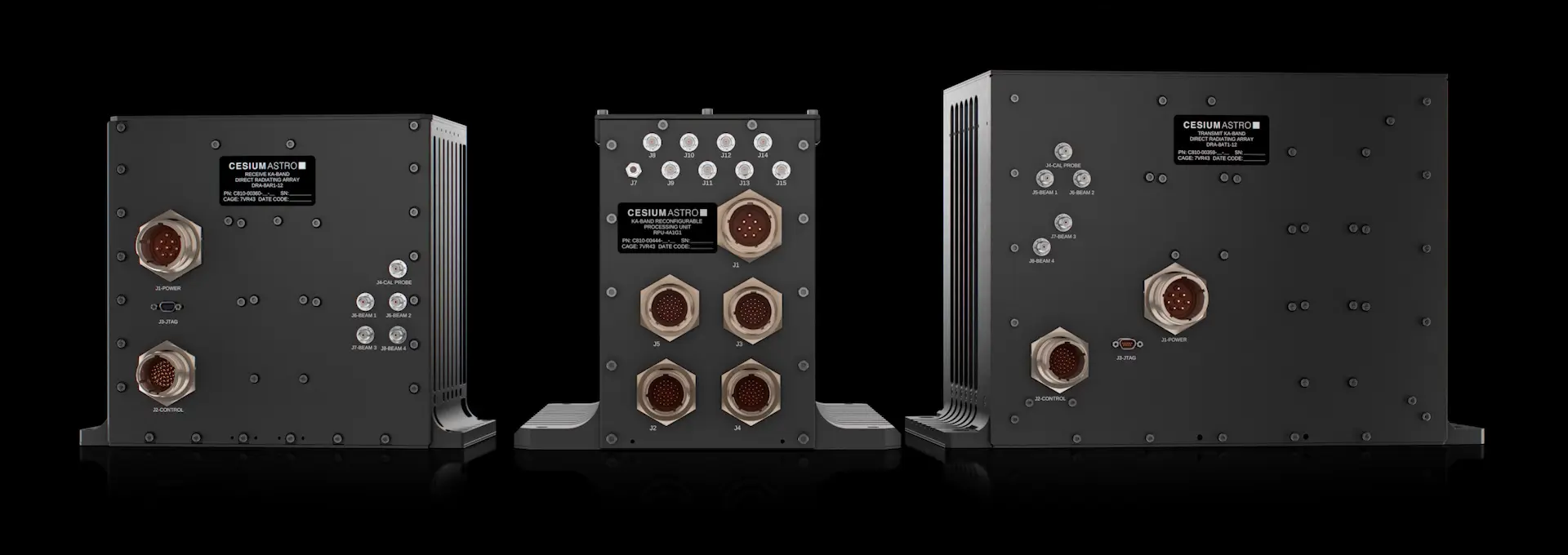
Vireo Ka 288 Transmit DRA

Provides Ka-band downlink capability for SDA tranches.

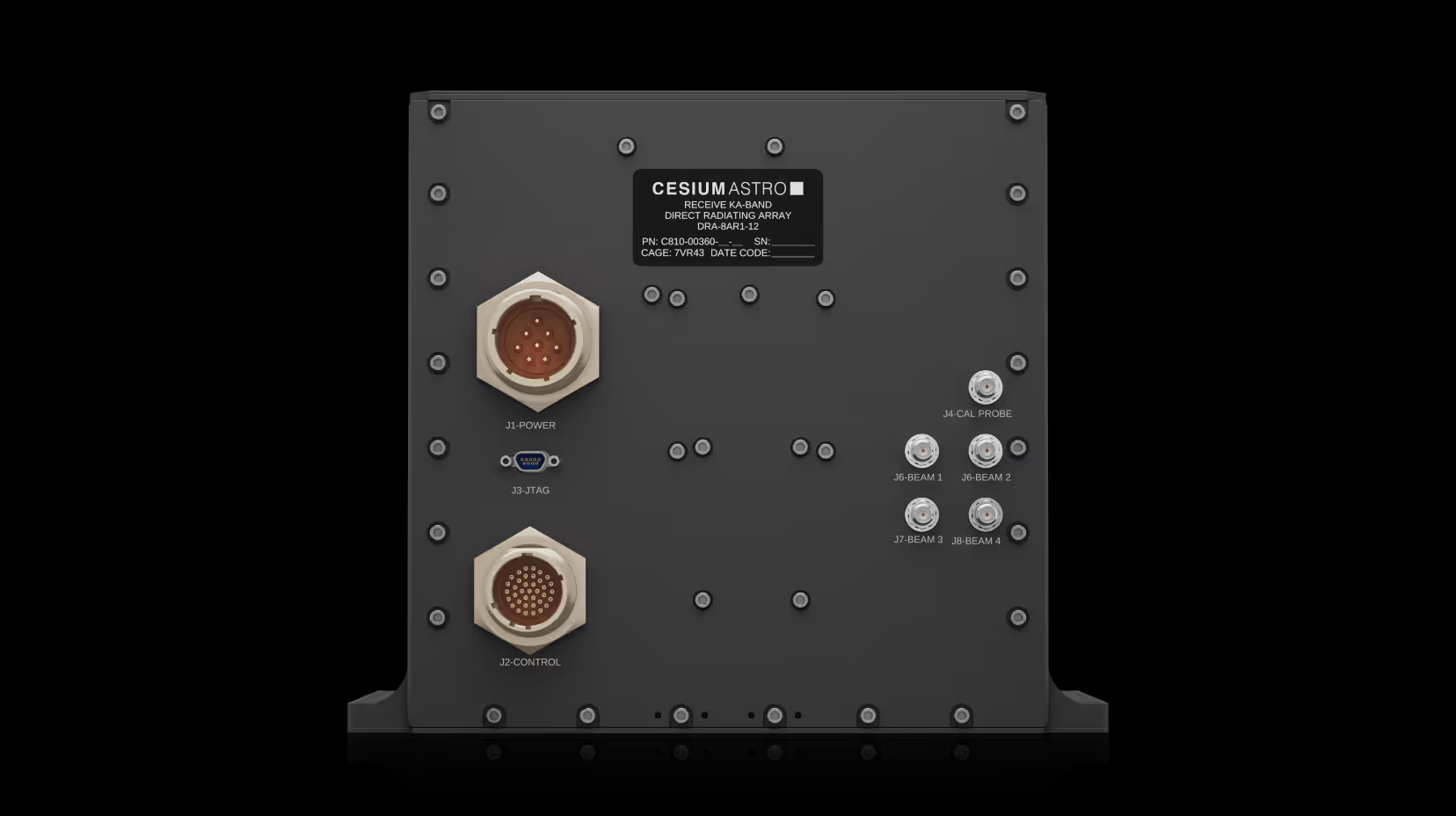
Vireo Ka 288 Receive Antenna

Provides Ka-band uplink capability for SDA tranches.

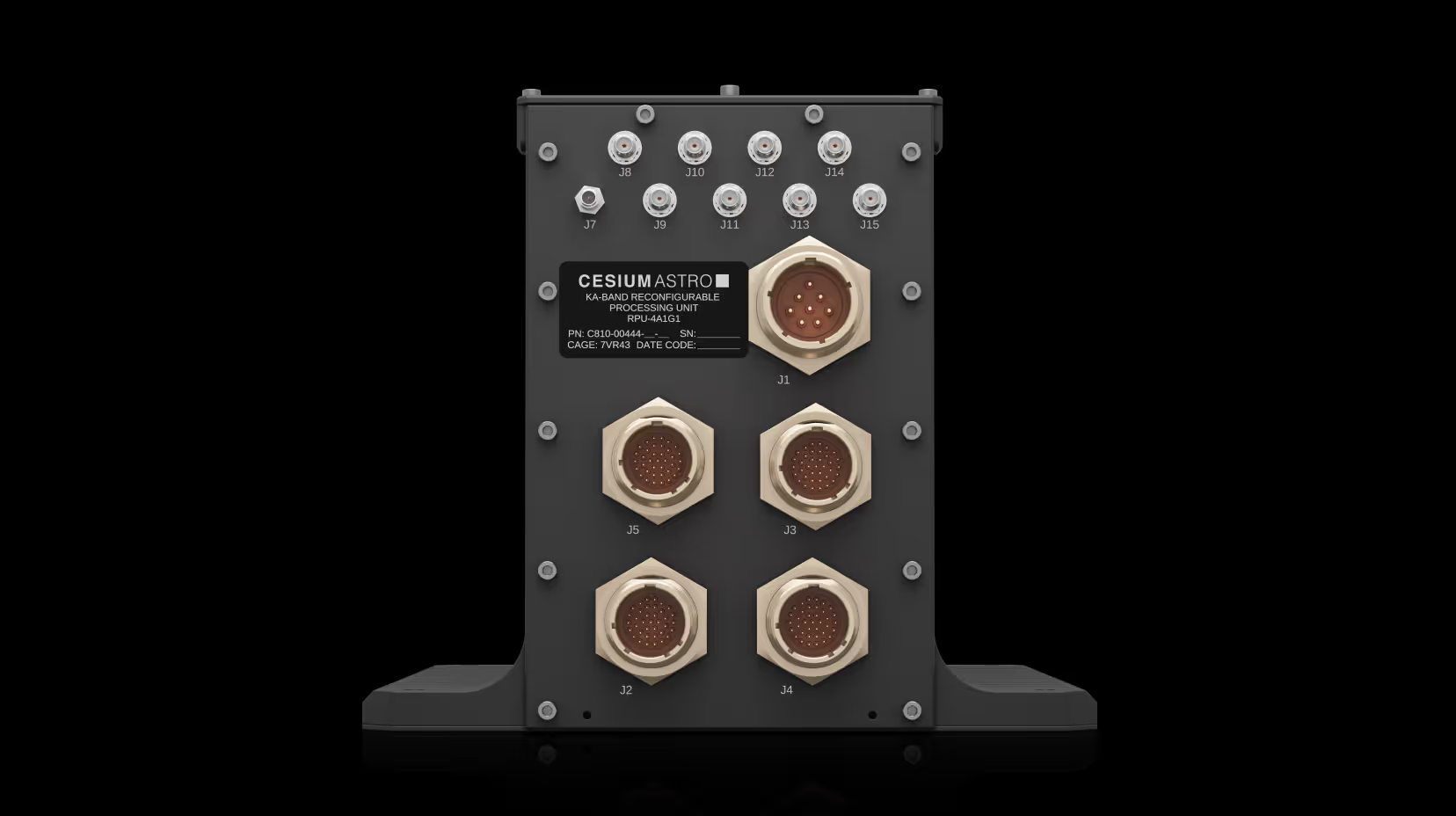
Ka-Band Reconfigurable Processing Unit

Enables Ka-band routing and processing for SDA tranches.
Overview

Vireo Ka 288 is a TRL 8 Ka-band communications payload designed for SDA Tranche-class proliferated LEO architectures.

It combines transmit/receive AESA antennas with a reconfigurable processor to enable multi-beam uplink/downlink operations, electronic beam steering, and dynamic power allocation. Built for manufacturability, repeatability, and constellation-scale deployment, Vireo Ka 288 offers prime integrators a scalable Ka-band payload solution for cost-effective SDA mission integration.

Applications

Data Downlink
TT&C

Payload Architecture

Reconfigurable Processing Unit (RPU)

Enables Ka-band routing and processing for SDA tranches.

Transmit Antenna

Provides Ka-band downlink capability for SDA tranches.

Receive Antenna

Provides Ka-band uplink capability for SDA tranches.

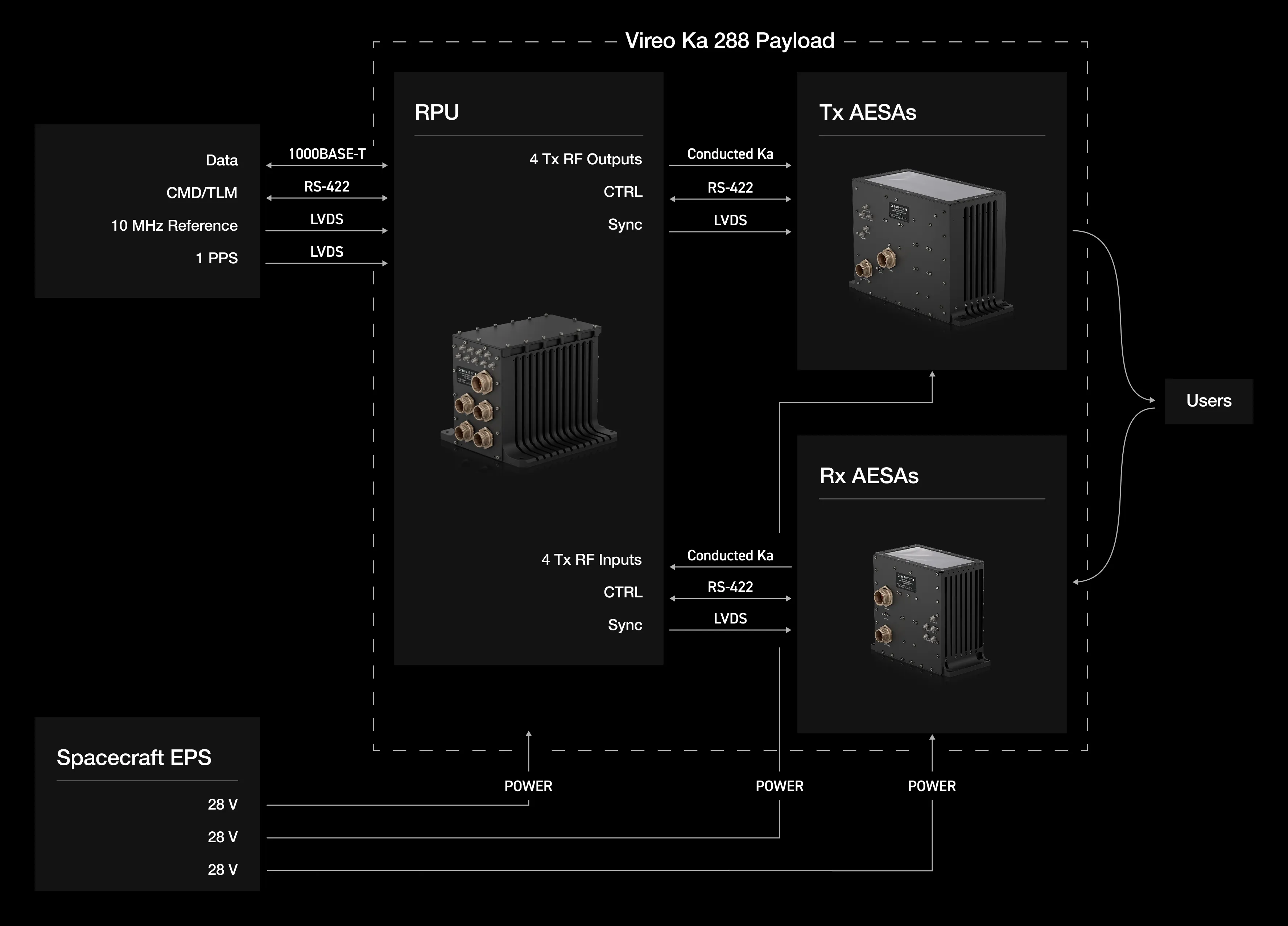
Integration Diagram

Specifications

Frequency
Tx AESA: 20.2 to 21.2 GHz
Rx AESA: 30 to 31 GHz
Channels
Tx: 4
Rx: 4
Polarization
RHCP or LHCP
(switchable on orbit)
Size
Tx AESA: 12.8” L x 6.1” W x 8.6” H
Rx AESA: 9.1” L x 5.1” W x 7.8” H
RPU: 10.0” L x 8.9” W x 7.7” H
Mass
24.1kg
DC Power
361 W
Waveform
DVB-S2X
Symbol rate
400 Msps
Data throughput
800 Mbps

Flight Qualified Hardware,
Shipping Today

“We’re pleased to be flying the CesiumAstro Vireo communications payload. The Vireo system’s advanced single- and multi-beam capabilities perfectly align with our Pioneer bus”
Brad Clevenger
Rocket Lab, Vice President of Space Systems
Read press release

Vireo Ka 288 RPU Interface Emulator

The RPU Interface Emulator enables flight-like digital validation of Vireo payload architectures before RF integration, allowing teams to develop, test, and integrate with confidence.

With direct access to SpaceVPX interfaces, onboard processing, and system interconnects, teams can prototype and refine mission configurations in a controlled lab environment. Removing RF hardware from the loop enables focused development of digital signal chains, data flow, and control software ahead of full payload integration.

The result is faster iteration, reduced integration risk, and a clearer path from development to flight.

Contact our team

Reach out to request a datasheet, learn more, or get in touch with our sales team.

We value your privacy. Your information is handled in accordance with our Privacy Policy
Thanks—submission received.
Error
Something went wrong while submitting the form. Please try again later.